Following the 2009 Pilkhana tragedy, a series of mysterious deaths and enforced disappearances involved witnesses and accused individuals of the BDR mutiny. Evidence reveals the involvement of former RAB official Ziaul Ahsan in these events. Documents retrieved from an investigation by Star News, statements from members of the probe commission, and testimony from a former RAB official indicate that Ziaul Ahsan played a role in eliminating key witnesses of the mutiny. A former official who worked alongside him even claimed that Ziaul Ahsan shot and killed several individuals with his own hands.
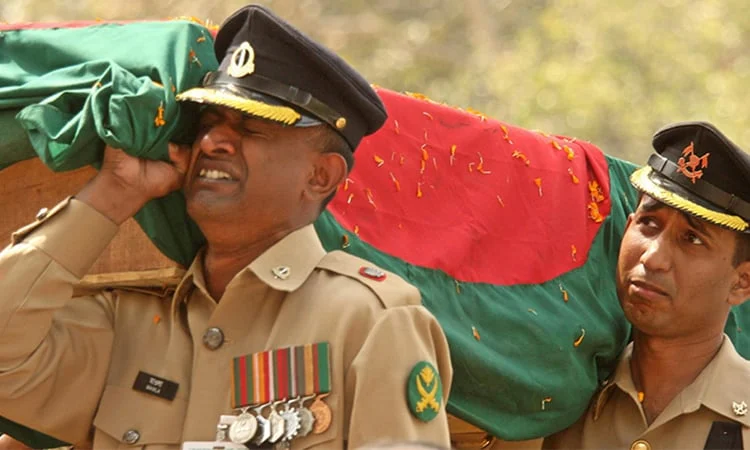
On 25 February 2009, army officers were brutally killed in Pilkhana under the guise of the BDR mutiny. Following the incident, separate investigation committees were formed by the government and the Bangladesh Army. As the probe committee began recording statements at the BDR headquarters, a series of mysterious deaths started taking place.
According to investigation data, 34 BDR members listed as accused or witnesses died within four months of the massacre. Within a year and a half of the mutiny, around a dozen more members disappeared. Some of them were witnesses, while others were accused.
One such individual was Maulana Siddiqur Rahman, the then-Imam of the Pilkhana Jamme Mosque. Although he had served in the BDR for twelve years, he had been stationed at Pilkhana for about two and a half years. On 25 February 2009, before the Durbar began, he recited from the Holy Quran. Shortly after, soldiers took up arms and gunfire erupted. Everything unfolded right before his eyes.
Siddiqur Rahman was named as a witness in the mutiny case. However, during the process of recording statements, he died suddenly. Questions remain over whether his death was natural. Star News launched an investigation to find the answer, traveling to Namajpur village in Pirojpur Sadar Upazila—a village along the Boleshwar River that remains untouched by modern developments. Navigating broken, narrow roads leads to a dilapidated tin-shed house where Maulana Siddiqur Rahman’s wife, Kamrun Nahar Shireen, resides.
She told Star News, “After finishing the Quran recitation, Siddiqur Rahman sat beside the officers. Soon after, soldiers surrounded the Director General (DG) and others. The officers then hid behind items placed behind the stage. He was with the officers as well. The DG called the Prime Minister right in front of him. He called the Army Chief too, but no one responded. A soldier then came up and said, ‘Hey Imam Sahib, what are you doing here? Get out.’ He was then escorted out of the Durbar Hall at gunpoint.”
A day later, on 26 February, after armed soldiers ordered everyone to leave following the massacre of army officers, Imam Siddiqur left with his family. About a week later, he returned to Pilkhana to give his testimony regarding the incident. However, according to his wife Shireen, he was subjected to immense psychological pressure as soon as he arrived.
She said, “He would call me from there and tell me that mental torture had begun against him. They told him, ‘There is no need for you to testify about so much. Just say that you saw nothing and left before anything happened.'”
Then one day, Shireen received a phone call informing her that her husband had fallen ill. After falling sick during interrogation, he was rushed to the hospital, where he passed away shortly after in front of his wife. However, Shireen claims his death was not natural.
She said, “The doctor came and said that all his internal organs had decomposed. But how could internal organs decompose within a few hours of a heart attack? The doctor told us not to comment on it and to leave the judgment to Allah. I am certain my husband was killed by lethal injection.”
Retired Brigadier General Hasan Nasir, a member of the inquiry commission formed by the Ministry of Home Affairs, also highlighted the mysterious deaths of the witnesses. According to him, as the commission began its work, individuals coming forward to testify began dying one after another. Initially, these deaths were attributed to suicide, and later to heart attacks. These incidents occurred while the commission’s activities were actively ongoing.
The death of a BDR member named Moazzem also raised suspicions among commission members. Hasan Nasir stated that Moazzem had wanted to testify before the commission himself. He was told to come the next day. However, when the commission went to Pilkhana the following day, he was nowhere to be found. Later, his body was discovered inside a barrack washroom.
Star News obtained video footage from 16 years ago showing the recovery of the body. The footage shows Moazzem’s body hanging by a piece of cloth from the ventilator of a small washroom. Hasan Nasir claimed that based on the positioning of the body, it did not appear to be a suicide; rather, he was killed and subsequently hanged.
Hasan Nasir further alleged that after being taken to the RAB’s Task Force for Interrogation (TFI) Cell and the Police’s Criminal Investigation Department (CID) under the pretext of interrogation, many witnesses and accused went missing. He noted that even while depositions were being given in court, RAB personnel would arrive and take away the accused, which he believes disrupted the trial process.
To identify those behind these disappearances and killings, Star News collected several documents from the archives of various government offices and intelligence agencies. Among those documents, a statement from an individual named Imrul Kayes detailed how witnesses of the BDR mutiny were eliminated.
In his statement, Imrul Kayes revealed that witnesses were killed in two ways: either by lethal injection or by being murdered and dumped into rivers. According to his account, detained individuals were taken from the Postogola Army Camp to the Buriganga River. There, they were shot in the head, their abdomens were slit, tied to cement bags, and thrown into the river. He stated that in 2010, at least 12 BDR members were forcibly disappeared in this manner.
Imrul Kayes’s statement named Ziaul Ahsan, the then-Director of RAB’s Intelligence Wing, as the leader of these operations. Kayes identified himself as Ziaul Ahsan’s bodyguard.
A former official who worked alongside Ziaul Ahsan in RAB’s Intelligence Wing spoke to Star News on the matter. Requesting anonymity for safety reasons, he stated that he was part of the team involved in picking up and disappearing BDR members. He personally witnessed several killings while accompanying Ziaul Ahsan. The former official stated that Ziaul Ahsan fired the shots himself and that no one dared to disobey his orders.
Ziaul Ahsan’s name also emerged in connection with the disappearance of BDR member Nazrul Islam. In November 2025, an investigative report by Star News titled ‘Gumchor’ (The Disappearance Files) revealed that Nazrul Islam was abducted, killed, and dumped into the Boleshwar River in Patharghata, Barguna.
Regarding Nazrul’s disappearance, retired Major Ekramul Huq Khan, a former Zonal Field Security Officer of the BGB, shared his account. He stated that after hearing RAB had picked up Nazrul, he questioned Ziaul Ahsan about him. In response, Ziaul told him not to look for Nazrul anymore, remarking that he was “in the stomach of the fish.”
Ekramul Huq Khan added that Ziaul Ahsan later disclosed that then-Prime Minister Sheikh Hasina and her Security Affairs Adviser Tarique Ahmed Siddique were aware of these actions. The retired army officer claimed Ziaul stated he was operating directly under their orders.
Major General Mainul Islam, who assumed charge as the first Director General of the BGB after the BDR mutiny, was contacted by Star News regarding these allegations. However, he stated over the phone that they had no connection to these events and that the police and CID handled the matters.
On the other hand, probe commission member Hasan Nasir stated that the then-DG of BGB had compiled a list of witnesses and handed it over to RAB. He maintained that the then-head of BGB, who was in charge of the Pilkhana headquarters, ought to have known about these occurrences.
Kamrun Nahar Shireen, wife of Pilkhana mosque Imam Siddiqur Rahman who died while attempting to testify, has carried unanswered questions about her husband’s suspicious death for 16 years. She shared that she did not even express her suspicions regarding his unnatural death to her children, fearing that speaking out might lead to their disappearance as well.
The investigation revealed that it was not only BDR mutiny witnesses or accused individuals who disappeared during that period. Among others missing is Bishwamitra Barua from Satkania, Chittagong, who served in the BDR’s Brahmanbaria Battalion. His family claims he was at home on leave during the massacre of army officers at Pilkhana. Considering the chaotic situation following the mutiny, he did not rejoin service. The family fears he may have been forcibly disappeared precisely because he did not return to duty.
Bishwamitra’s mother, Dipali Barua, has been waiting for her son for 17 years and has not given up hope of his return. Yet, why her son vanished, who picked him up, and where he is today remain questions to which the family still has no answers.
Just as the families of the army officers killed at Pilkhana seek justice for the massacre, the families of those subjected to enforced disappearance and extrajudicial killing after the BDR mutiny are demanding a fair investigation and justice.
While the documents and testimonies uncovered by Star News are significant, the full mystery behind the deaths and disappearances of the BDR mutiny witnesses remains unraveled. Stakeholders believe an impartial investigation into these disappearances and killings is essential to unmasking the masterminds and command structures behind the Pilkhana massacre.