
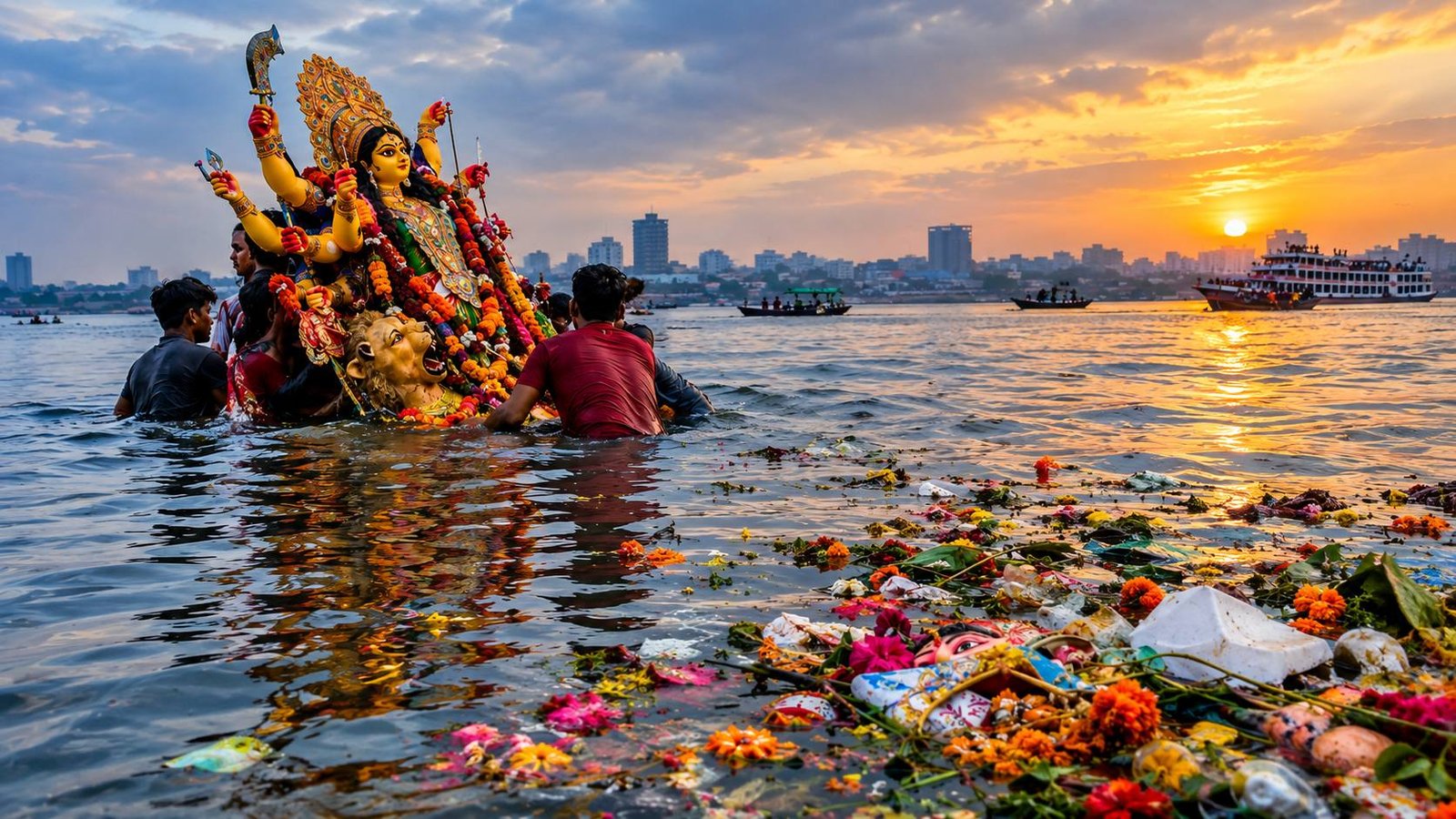
Scientific studies in India have linked idol immersion to deteriorating water quality and heavy-metal contamination. As Bangladesh’s rivers face existing pollution pressures, questions are growing over the environmental impact of the practice and whether all religious festivals receive equal attention from environmental advocates.
The Sharadiya Durga Puja festivities concluded across Bangladesh on Wednesday, October 21, with idols immersed in rivers, ponds and other water bodies on the occasion of Bijoya Dashami. As thousands of devotees bid farewell to the goddess, concerns remain over the potential impact of paints, chemicals and decorative materials on aquatic ecosystems.
More than 33,000 puja mandaps were reported across the country this year, around 1,500 more than in 2025, according to figures cited in local reporting. However, published reports have given differing totals, and the final official figure should be confirmed before publication. In Dhaka, the Buriganga River is among the principal locations used for idol immersion.
While immersion is an integral part of the religious observance, it raises an environmental question: what happens when paints, chemical coatings and decorative materials used on idols enter rivers and other water bodies?
Research conducted in India has documented changes in water quality following religious idol immersion. Reports from India’s Central Pollution Control Board (CPCB) and related environmental monitoring have examined changes in acidity, total dissolved solids (TDS), dissolved oxygen and the concentrations of metals in water bodies.
A CPCB presentation examining the impact of Ganesh idol immersion in lakes in Bengaluru reported an increase in acidity and a 100 percent rise in TDS. It also described iron concentrations increasing nearly tenfold, while copper concentrations in sediments rose by 200 to 300 percent. These figures relate to the specific monitoring discussed in that presentation and should not be interpreted as universal outcomes for every immersion site.
Changes in water chemistry and dissolved oxygen can affect aquatic organisms, while certain metals may pose risks when they accumulate in water, sediments or living organisms. The scale of the impact depends on the materials used, the number of idols immersed and the characteristics of each water body.
The materials used to make idols are therefore an important consideration. Depending on local practices, idols may contain plaster of Paris, synthetic paints, plastic and thermocol decorations. When these materials enter water bodies, they can release pollutants or leave solid waste behind.
A study published in SpringerPlus in November 2014 examined water and tilapia fish in three lakes in Nagpur, India: Futala, Gandhisagar and Ambazari.
Researchers analysed samples collected before and after idol immersion and reported increases in several metals, including lead, cadmium, copper, iron and manganese. The study found greater contamination in Gandhisagar Lake following immersion and reported elevated concentrations of lead and cadmium in fish.
The researchers warned that heavy metals accumulating in aquatic organisms could create environmental and human-health risks, particularly when contaminated fish enter the food chain.
The findings highlight a potential pathway through which pollutants can move from water bodies into aquatic organisms and ultimately reach people who consume them. However, the extent of any risk depends on the concentration of contaminants, exposure levels and local conditions.
Environmental scientists have also raised concerns about paints containing hazardous metals such as lead and chromium. Depending on their composition and concentration, these substances can harm aquatic organisms and vegetation and disturb the ecological balance of water bodies.
However, findings from Indian lakes cannot automatically be applied to Bangladesh. Local water-quality testing is needed to establish whether similar effects occur at Bangladeshi immersion sites and, if so, how severe they are.
Bangladesh’s rivers already face considerable pressure from industrial discharge, untreated sewage and other sources of pollution. The Buriganga, which flows alongside Dhaka, has been the subject of scientific research documenting heavy-metal contamination.
A 2023 study published in Heliyon analysed heavy metals in fish from the Buriganga River. Researchers detected several metals, including lead, nickel, cadmium and zinc, and identified potential human-health concerns associated with some of the measured concentrations.
The findings underline the environmental challenges facing the river. They do not, however, establish that idol immersion is responsible for the contamination detected in the fish.
Industrial waste and sewage remain important pollution concerns. Determining whether idol immersion adds to the river’s pollution burden would require targeted sampling before and after immersion, with tests designed to distinguish its effects from those of other pollution sources.
Despite the existing research on the Buriganga’s pollution, publicly accessible evidence specifically measuring the contribution of Durga idol immersion in Bangladesh remains limited. The extent of any additional contamination therefore cannot be reliably quantified without dedicated investigation.
This gap in evidence highlights the need for systematic monitoring rather than assumptions about the scale of the problem.
In India, the environmental consequences of idol immersion have prompted scientific investigations, regulatory measures and legal proceedings.
The CPCB’s revised guidelines recommend using natural, biodegradable materials and safer colouring agents. They also encourage designated artificial immersion ponds or tanks where feasible, the removal of flowers and artificial ornaments before immersion, and the proper collection and disposal of solid waste afterward.
The guidelines outline responsibilities for local authorities and organisers, including arrangements for waste management and water-quality monitoring. Legal proceedings in India have also addressed the environmental consequences of immersion and the use of certain idol-making materials.
Some puja committees and local authorities have supported environmentally conscious practices, including designated immersion facilities and the removal of decorative materials before idols enter water bodies.
These measures demonstrate that environmental protection can be pursued without dismissing the religious significance of the ritual. Their effectiveness, however, depends on implementation, monitoring and cooperation among organisers, authorities and communities.
Bangladesh could examine these experiences and assess whether similar measures would be suitable for its rivers and water bodies, taking local environmental conditions and religious practices into account.
The issue also raises questions about the consistency of environmental advocacy in Bangladesh, particularly when the environmental impact of different religious festivals is considered.
Every year, waste generated during Eid-ul-Adha—particularly animal remains and other organic waste from ritual sacrifice—receives considerable public attention. Municipal authorities, environmental organisations and other stakeholders often call for proper waste disposal, improved sanitation and public awareness campaigns to prevent pollution and protect public health.
By contrast, the potential environmental impact of idol immersion after Durga Puja appears to receive comparatively less attention in public discussions. The paints, chemical coatings and decorative materials used on idols may also introduce pollutants into rivers and other water bodies, making the issue worthy of scientific investigation and public awareness.
This comparison raises a fundamental question: should environmental concerns be addressed according to the same scientific standards, regardless of the religious festival involved?
The comparison does not mean that the two practices produce identical types or levels of pollution. Animal waste and idol-making materials pose different environmental challenges and require different management measures. The extent of public attention given to each issue would also need to be assessed systematically before drawing definitive conclusions about the activities of environmental organisations.
Nevertheless, environmental protection should be guided by evidence rather than religious identity. If campaigns are organised to raise awareness about waste generated during Eid-ul-Adha, there is equally a case for examining and communicating the potential environmental consequences of idol immersion during Durga Puja.
The objective should not be to criticise any religious community, but to ensure that all environmental risks receive fair, proportionate and evidence-based attention. Consistent standards, independent research and practical waste-management measures can help protect rivers and public health while respecting the religious traditions of all communities.
Environmental experts and relevant authorities could begin by monitoring major immersion sites, including the Buriganga and other rivers and ponds used during Durga Puja.
Water samples collected before and after immersion could be tested for acidity, dissolved oxygen, TDS, suspended solids and potentially hazardous metals. Sediment samples could also help establish whether pollutants accumulate on riverbeds.
Such monitoring would help determine whether immersion causes measurable changes in local water quality and whether those changes are significant compared with pollution from industrial discharge, sewage and other sources.
Authorities could also consider clear guidelines on idol-making materials, synthetic paints, decorative accessories, designated immersion locations and post-immersion waste collection. Organisers could be encouraged to use safer materials and remove non-biodegradable decorations before immersion.
Public awareness campaigns could explain how to reduce environmental harm without interfering with religious observances. Cooperation among government agencies, puja committees, environmental scientists and civil society organisations would be essential to making such measures effective.
The goal should be to establish a reliable evidence base before making definitive claims about the scale of pollution attributable to the practice.
The Durga Puja celebrations may have ended, but the environmental questions remain. Protecting rivers and aquatic life requires scientific research, transparent monitoring and consistent environmental standards—applied fairly across all religious and cultural practices.