
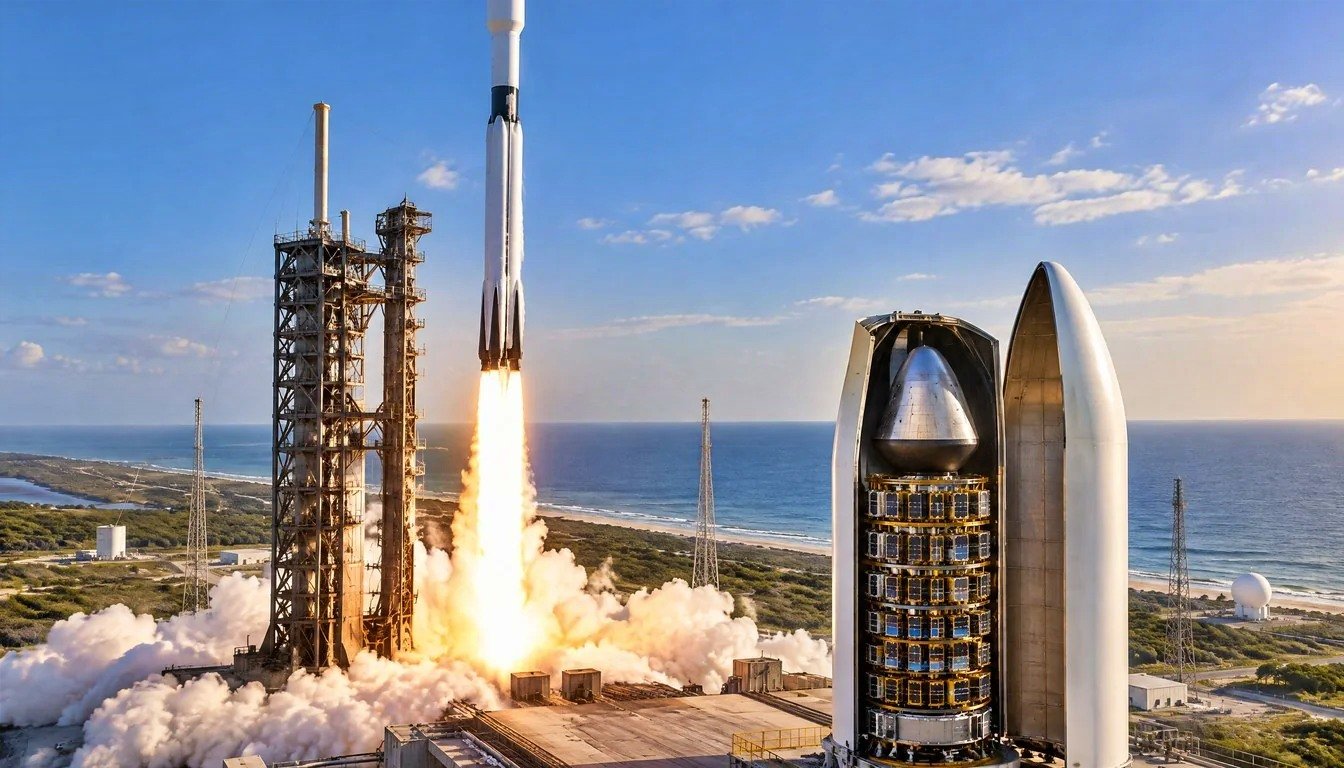
SpaceX has postponed the launch of its Bandwagon-5 rideshare mission, which is set to carry the company’s uncrewed Starfall reentry capsule and 31 customer payloads into space. The launch was called off on Monday because of unfavourable weather conditions in the rocket booster’s recovery zone.
The company is now targeting Tuesday, October 20, for the launch from Cape Canaveral Space Force Station in Florida, according to Spaceflight Now. The one-hour launch window is scheduled to open at 6:30 a.m. Eastern Daylight Time (1030 UTC), equivalent to 4:30 p.m. Bangladesh time.
The mission will use a Falcon 9 rocket launching from Space Launch Complex 40. The schedule remains subject to weather and operational conditions.
SpaceX cancelled Monday’s launch attempt because weather conditions in the booster recovery zone were unsuitable for the planned operation.
The 45th Weather Squadron had identified concerns involving high winds, cloud development and conditions at the Atlantic Ocean recovery site. Although launch conditions and booster recovery conditions are assessed separately, both are important to the overall mission.
For Tuesday’s attempt, forecasters expect improving conditions as a cold front moves farther south across Florida. Spaceflight Now reported a 90 per cent probability of acceptable weather during the revised launch window, although some uncertainty remains around conditions at the recovery site.
The postponement illustrates one of the operational challenges facing reusable launch systems: a rocket must not only lift off safely but also meet the environmental requirements for recovering its first stage when recovery is planned.
The Bandwagon-5 mission will carry 32 payloads in total: SpaceX’s Starfall capsule and 31 customer payloads.
The rideshare flight is designed to deploy spacecraft for multiple organisations on a single rocket, allowing satellite operators to share launch costs and access space without arranging individual launches.
Twenty of the customer payloads are managed through multinational mission management company Exolaunch. They include four radio-frequency monitoring satellites from Virginia-based HawkEye 360, four communications satellites for Finnish satellite company ICEYE and six navigation satellites from California-based Xona Space Systems.
Other payloads include spacecraft from satellite operators and technology companies working on communications, Earth observation, navigation and orbital manoeuvring.
Starfall is an uncrewed spacecraft developed by SpaceX to support research and manufacturing in microgravity and return materials from orbit to Earth.
SpaceX first introduced the capsule during a mission in June 2026. The company has described Starfall as a platform that researchers and businesses can use to develop products and innovations in the microgravity environment of space.
According to an environmental assessment by the US Federal Aviation Administration cited by Spaceflight Now, the capsule measures approximately 3.1 metres in diameter and 0.75 metres in height. Its mass is around 2,100 kilograms, and it can accommodate up to 1,000 kilograms of payload.
The Bandwagon-5 flight is expected to be the second launch of the uncrewed Starfall capsule. However, SpaceX has not publicly disclosed the specific research materials or experiments, if any, that will be carried inside the vehicle on this mission.
The technology could eventually support research in biotechnology, pharmaceutical development and advanced materials by enabling experiments to be conducted in orbit before their products are returned to Earth.
In September, Reuters reported that Luxembourg-based Space Cargo had become the first known European customer for the Starfall programme. The company plans a mission targeted for 2028 using SpaceX’s Starship and Starfall to return materials associated with its BentoBox research system.
Starfall will not be the only reentry vehicle associated with the Bandwagon-5 mission.
Varda Space Industries is also launching its W-Series 7 spacecraft, which is designed to conduct research in orbit and return its payload to Earth.
The spacecraft will carry an experiment involving Protac, a class of molecules being investigated for potential cancer treatments. Varda says microgravity can affect how molecules crystallise, potentially producing crystal forms with different properties, including improved solubility.
The experiment could help researchers better understand whether manufacturing certain pharmaceutical compounds in space offers advantages over production on Earth. Its results will need to be assessed scientifically before any conclusions can be drawn about potential medical applications.
The presence of multiple reentry systems on the same rideshare mission highlights growing commercial interest in returning experimental materials from orbit rather than simply placing satellites in space.
The mission will also carry Starburst-1, a demonstration spacecraft developed by Portal Space Systems.
Weighing approximately 260 kilograms, Starburst-1 is designed to demonstrate orbital manoeuvring capabilities and support a customer payload of up to 50 kilograms.
Portal Space Systems has described the mission as a privately funded demonstration intended to validate the technology before future customer missions, which the company has advertised as beginning in 2027.
Successful testing could help demonstrate new ways for spacecraft to change their orbits and carry out missions that require greater manoeuvrability.
SpaceX plans to use Falcon 9 first-stage booster B1085 for the Bandwagon-5 mission. The booster is scheduled to make its 19th flight, following earlier missions that included NASA’s Crew-9, Firefly Aerospace’s Blue Ghost Mission 1 and several commercial satellite launches.
After the rocket’s stages separate, the first stage is expected to return to the Atlantic Ocean and land on SpaceX’s autonomous droneship, A Shortfall of Gravitas.
If successful, the recovery would contribute to SpaceX’s continued use of reusable rocket technology, which is intended to reduce the need to manufacture a new first-stage booster for every mission.
The second stage will continue towards the target orbit and deploy the mission’s payloads according to the flight plan.
The next launch attempt is scheduled for Tuesday, October 20, subject to updated weather forecasts and operational readiness.
Beyond deploying 31 customer payloads, the mission will provide another opportunity for SpaceX to test its Starfall reentry technology and for commercial operators to demonstrate spacecraft designed for research, navigation, communications and orbital manoeuvring.
The results could help shape the development of commercial services that combine satellite deployment with the recovery of materials produced or studied in space.
For now, the immediate priority is a safe launch and successful completion of the mission’s planned operations.
Sources: Spaceflight Now, SpaceX, Reuters.